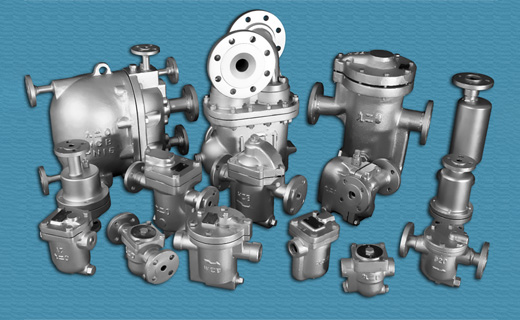
1. Thermodynamic Traps
Compact and lightweight, thermodynamic traps are easy to install and maintain, offering low cost, strong water hammer resistance, and freeze‑resistant performance. They are not recommended for high‑capacity applications. Allowable backpressure is generally not less than 50%, with pulse‑type units at not less than 25%.
(1) Disc Traps
These feature a simple structure with intermittent discharge and moderate noise levels. They can discharge condensate near saturation temperature, with subcooling of 6°C to 8°C and a typical steam leakage rate of about 3%. They are self‑venting and resistant to water hammer. Backpressure should not exceed 50% of the minimum inlet pressure, with a minimum working differential pressure of ΔP = 0.05 MPa. Installation orientation is not restricted; vertical downward installation is recommended for freeze‑prone conditions.
(2) Pulse Traps
These have a simple structure and provide continuous discharge but exhibit relatively high steam leakage and lower allowable backpressure (approximately 25%).
(3) Labyrinth and Micro‑Orifice Traps
Both types offer simple construction with continuous discharge and venting capability. Micro‑orifice designs are suited for small capacities, while labyrinth types handle larger flows. However, they are less adaptable to significant pressure and flow variations, and care should be taken to avoid blockage and erosion in the flow path.
2. Thermostatic Traps
These traps operate more quietly than other types and remain open at low temperatures, allowing accumulated condensate to be discharged quickly during startup or shutdown to help prevent freezing. Because they rely on temperature differentials, their response is less rapid and they are less suited to sudden load changes, making them more suitable for stable, low‑pressure applications. Allowable backpressure is generally not less than 30%.
(1) Liquid‑Expansion or Solid‑Expansion Traps
These have a more complex structure and lower sensitivity. They can discharge condensate at temperatures between 60°C and 100°C and are also capable of venting air. They are suitable for low‑temperature heat tracing and heating pipelines.
(2) Diaphragm‑Type Thermostatic Traps
These offer a simple structure, sensitive operation, continuous discharge, and good air‑venting capability. Subcooling ranges from 3°C to 20°C, with allowable backpressure of 30% to 60% and steam leakage below 3%. Installation orientation is not restricted, though resistance to fouling and water hammer is moderate. They may also serve as air vents in steam systems.
(3) Bellows‑Type Thermostatic Traps
These feature simple construction, sensitive action, and intermittent discharge with subcooling around 20°C. Operating pressure is generally limited to 1.6 MPaG due to bellows material constraints. Resistance to fouling and water hammer is moderate, and they can also function as air vents.
(4) Bimetal Traps
These provide sensitive operation, continuous discharge, good drainage performance, and adjustable subcooling with excellent air‑venting capability. Reverse‑sealing versions also offer check function. Maximum operating pressure can reach 21.5 MPaG and temperatures up to 550°C. They are resistant to fouling and water hammer, with allowable backpressure up to 50% of inlet pressure (adjustable for higher backpressure). They can also serve as system air vents.
(5) Bimetal Temperature‑Adjustable Traps (TB Series)
These allow manual control of condensate discharge temperature to utilize sensible heat from high‑temperature condensate effectively. They feature a "self‑closing, self‑centering, self‑seating" valve system, offering long service life, compact size, and flexible installation. They provide continuous discharge, excellent venting performance, and allowable backpressure up to 80%, with notable energy‑saving benefits.
3. Mechanical Traps
These traps operate quietly, discharge condensate quickly, and are generally larger than other types. They require horizontal installation and are suitable for high‑capacity applications. Allowable backpressure is generally not less than 80%.
(1) Free‑Float® Traps
These offer a simple structure, high sensitivity, continuous discharge, and low steam leakage. They are available in versions with or without automatic air‑venting capability. When the non‑venting version is selected, an additional thermostatic air vent or manual vent valve is required. Maximum operating pressure is 9.0 MPaG, with allowable backpressure up to 80%. Resistance to water hammer and fouling is moderate, and operation is steady and reliable, though somewhat slower.
(2) Lever‑Float Traps
These have a more complex structure with slightly lower sensitivity, continuous discharge, and low steam leakage. They are offered with or without automatic air‑venting capability. If the latter is chosen, a supplemental thermostatic vent or manual venting valve is needed. They can adapt to load changes and adjust discharge capacity automatically, though resistance to water hammer and fouling is moderate.
(3) Float‑Type Balanced Double‑Seat Traps (G Series)
These offer high discharge capacity, up to 60 t/h, with a compact and lightweight design compared to similar products. They incorporate a bimetal air vent for automatic air removal and are equipped with volatile liquid inside the float to enhance pressure and water hammer resistance. Continuous discharge is standard.
(4) Inverted‑Bucket (Bell‑Float) Traps
These discharge condensate intermittently with steam leakage typically between 2% and 3%. They are self‑venting and adapt automatically to operating conditions, with a rated working pressure below 1.6 MPaG. Allowable backpressure is 80%, with a minimum inlet‑outlet differential pressure of 0.05 MPa. Operation is steady and reliable, though the structure is more complex, and the valve seat and pin tips may be subject to wear. Priming before use is recommended.
(5) Lever‑Type Inverted‑Bucket Traps (ES Series)
These use a lever mechanism to increase opening and closing force, enhancing discharge capacity while enabling soft landing of the floating valve core for smooth operation and extended service life. They offer good steam‑blocking and drainage performance, automatic air venting, allowable backpressure up to 80%, and strong fouling resistance. Compared to similar models, they are compact and provide high capacity with easy maintenance.
(6) Differential‑Pressure Inverted‑Bucket Traps (ER Series)
These incorporate a "self‑closing, self‑centering, self‑seating" system for reliable performance and long service life. They operate with smooth, low‑vibration action and overcome impact‑wear issues through a dual‑closing arrangement. Compared to similar traps, they offer compact size, high capacity, and good structural strength.
4. Other Trap Types
Some traps combine features of two or more types—thermodynamic, thermostatic, or mechanical—and may include functions not found in conventional designs. For example, float‑type bimetal traps have a more complex structure but provide integrated functions including trapping, straining, air venting, check, stop, and bypass capabilities, and can operate effectively within specified ranges. Anti‑freeze versions require horizontal installation.